Dr. Barbara Thakor
Teaching Assistant
Professor
Plant Biology and Evolution
|
|
Courses
taught:
PB 250 - PB
250L
Plant Biology
PB 295E Topics in Plant Evolution
|
|
|
| |
|
Teaching
Interests:
Many
years ago I began my professional teaching career in Zoology
then entered the fascinating realm of Plant Biology about 12
years ago - my second career. I received my PhD from UNC, Chapel
Hill in 1998. In spring of 2000, I began my association with
the Plant Biology Department of NCSU where I am currently employed
as a Teaching Assistant Professor of Plant Biology. Since joining
the NCSU faculty, I have taught various courses: PB 403 and
PB 403L Plant Systematics, PB400 and PB400L Plant Diversity,
PB200H and PB200HL Honors Plant Life and for the past 3 years
I have been teaching PB250 and PB250L Plant Biology. My major
interest lies in providing students with a firm foundation in
the basics of Plant Biology so they are well prepared to undertake
more advanced courses in Plant Sciences.
Highlights
of PB 250 and PB 250L
The sample syllabus included on this
web site presents the details of the PB 250 and PB 250L
course contents and the amount of time devoted to each topic.
It states course assignments, textbooks required, grade
determination method, and expectations regarding attendance. Included
in the syllabus is a list of course objectives and a questionnaire
which enrolled students must complete.
In
PB 250 I attempt, in so far as the calendar permits, to coordinate
lecture and laboratory topics. I
consider the lecture and lab to comprise an integral, interdependent
entity. PB250 is an
introductory course where the basic terms and concepts of
the science are presented and as such is quite structured.
Lectures are Power Point presentations. There is a WEB site
for PB 250 (vista.ncsu.edu), available to students enrolled in
the course, on which my lecture Power Point files are available.
The
PB250L has been technologically updated recently and possesses
much state of the art equipment enabling students to have meaningful
modernized lab experiences. You will be exposed to the basics
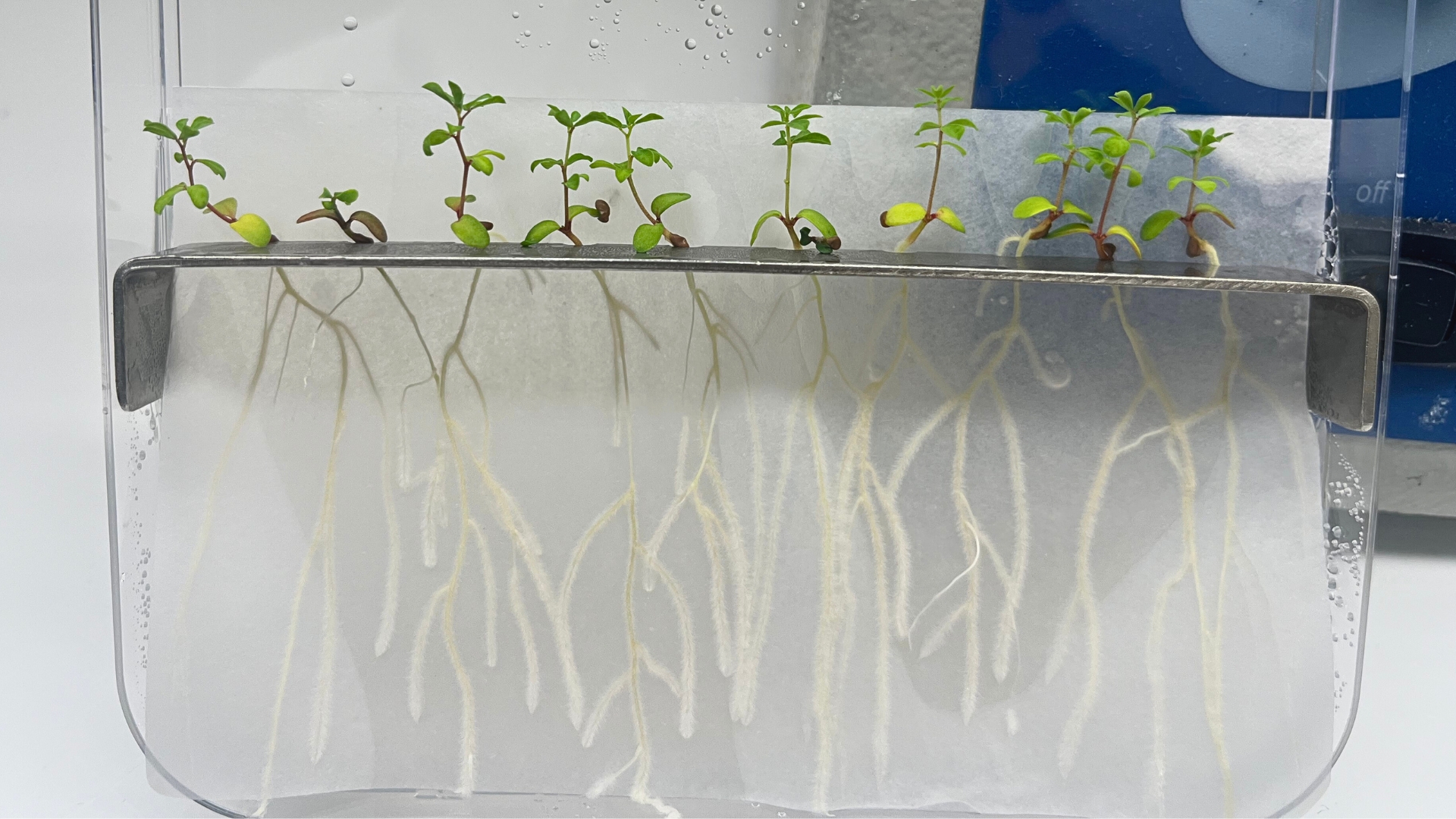
of Tissue Culture made possible by our recent acquisition of
a Laminar Flow Unit (Fig 1). Fig 2 shows tissue cultures developing.
|

Fig.
1 Working at Laminar Flow Unit
|

Fig.
2 Developing Tissue Cultures
|
| |
Photosynthesis
and Nitrogen Fixation will be investigated using our newly
acquired Qubit Systems equipment that enables real time experimental
data collection and analysis in conjunction with our laptop
computers (Fig. 3).
|

Fig.
3 Nitrogen fixation lab
|
|
The lab room has a teaching demonstration
microscope/camera/computer setup so live and preserved specimens
can be viewed by all students simultaneously on the 2 overhead monitors
in the lab room (Fig. 4a, b). Students are encouraged to bring their
especially good specimens to this setup in order to share them with
the entire class. |

Fig.
4a Demonstration Scopes |

Fig.
4b Monitor showing lily pollen tubes
|
|
PB 250
has a collection of fantastic plant videos to provide you
with exposure to BOtanical materials that you might otherwise
never witness on your own in nature. The shorter videos
of our collection (10-20 min. each) are shown during lab
sessions (Fig. 5). You are also required for credit to view
10 of the longer plant videos (50 min. each) in the D. H.
Hill Library Media Center. Students of prior semesters have
rated these videos as one of the highlights of the course.
Fig. 5
Some of the videos in PB 250's video collection viewed during
lab sessions.
During Spring and Fall semesters we
take a ‘Campus Flora’ tour and also go to the NCSU Conservatory
for a ‘Global Plant Diversity’ lab that includes a modified plant
scavenger hunt (Fig. 6 ).

Fig.
6 NCSU Conservatory Field Trip
Where appropriate, I like to share with my students the botanical
excursions I have personally experienced. In this regard, for
our Plant Ecology lecture slot, I take the students through various
NC ecosystems including those of ocean/sand dunes (Fig. 7), maritime
forest, salt water estuary, Green Swamp, and Long Leaf Pine Savannah
ecosystems. (We experience these NC ecosystems via a Power Point
presentation made possible from photos I took when I accompanied
Dr. Wentworth and his PB565 students through these ecosystems.)
Fig.
7 Sand Dunes/Ocean Ecosystem
During
one part of our Evolution Lab, students are taken to the Galapagos
Islands via Power Point to see how Darwin's journey there was ultimately
pivotal to the development of his Theory of Evolution. We view some
of the unusual plants and ecosystems of these islands (and also
some of the unusual animals for which these islands are famous)
made possible from photos taken during a trip I recently made to
these islands. (Fig. 8)
Fig. 8 Red Mangroves - low tide at sunset --Galapagos Islands
I
have compiled a Course Pac for PB250 that contains laboratory
exercises, worksheets for the Plant Diversity section of the
course, video worksheets to accompany your video viewing in
the D. H. Hill Library Media Center, and several items in an
APPENDIX. This Course Pac is printed by Tailored Text and is
updated yearly (Fig. 9). The textbook for the course is entitled
Biology of Plants and is authored by Peter Raven, Ray Evert,
and Susan Eichorn (7th ed., W.H. Freeman and Company Publishers)
(Fig. 10)

Fig 9. PB 250 Course Pac ------------------
Fig. 10. PB 250 TextBOok
|
|
|
|