/PB_logo_transparent.gif)
Dr. Jon M. Stucky -
Professor
Species biology of rare
plants and wetland ecology
Research Interests:
I
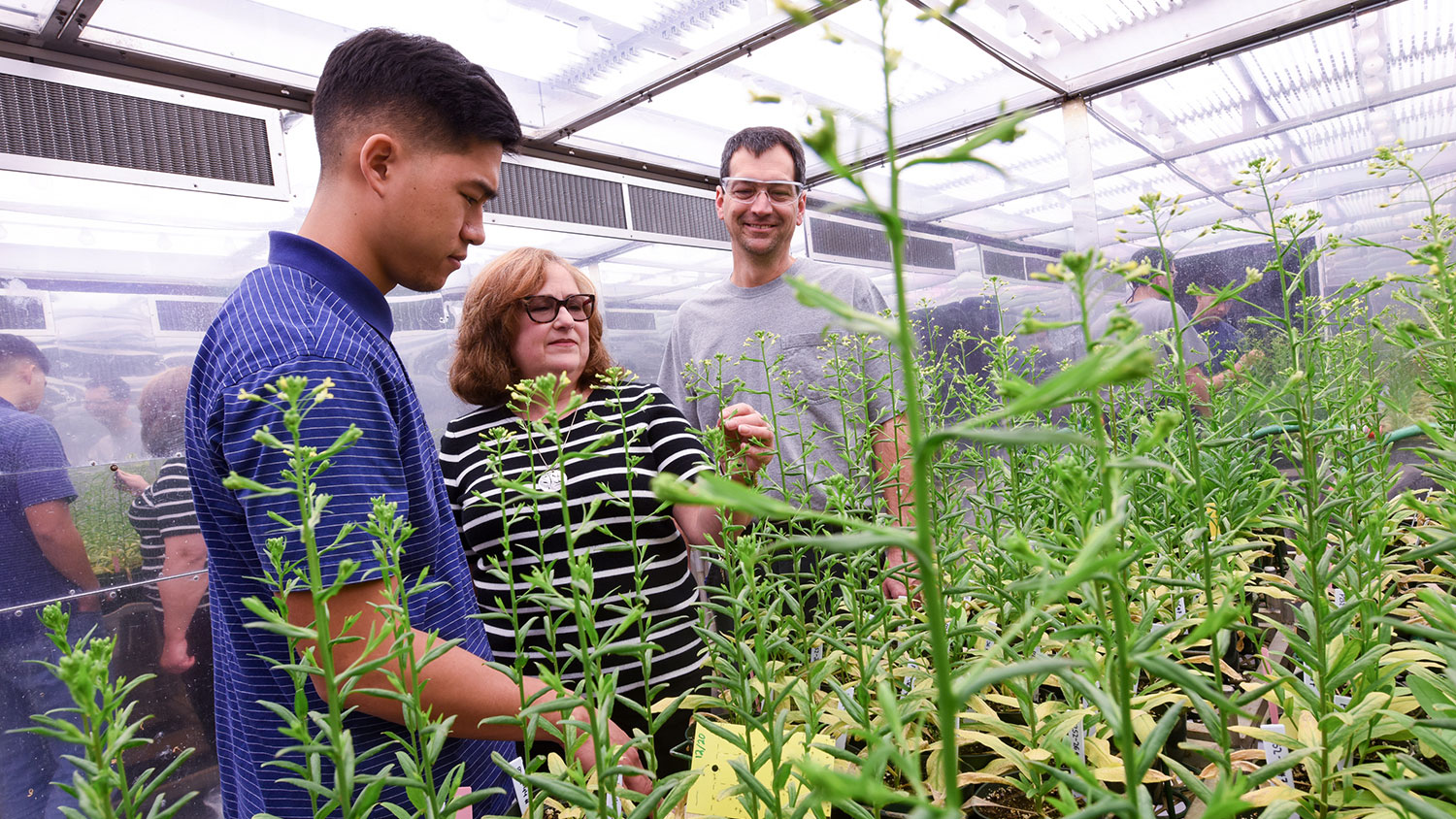
am committed to the conservation of biodiversity. My major research focuses
on one aspect of biodiversity, conservation of rare plant populations. The
broad goal of the work conducted by me and my students, both graduate and undergraduate,
is to develop knowledge of the biological characteristics of rare plant species
that will inform efforts to conserve these species. The particular work conducted
with individual species depends on the perceived threats to its conservation;
therefore, the goals of my various projects have varied considerably. For
example, we have recently determined that ineffective insect pollination
is one of several mechanisms that nearly totally preclude seed production
in rough leaf loosestrife, a federally endangered species. Given this knowledge,
we recommended that consideration be given to planting a thoroughly pollinated
species of loosestrife with mitigation plantings of rough leaf loosestrife
in hopes that insects will also visit it. Another study examined survivorship
and growth of spring-flowering goldenrod, a state endangered species, on
soils varying in wetness in the Croatan National Forest. Despite the fact
that this goldenrod is an obligate wetland species, its survivorship was
negligible on the wettest soil. Survivorship and growth were maximized on
drier soils. These results will inform the selection of a mitigation site
for transplanting this species from a large population that will be severely
impacted by a highway construction project. Another project nearing completion
involves determining whether or not seed production and fitness in small
populations of smooth coneflower, federally endangered, is less than that
in the single large population in North Carolina. Preliminary results suggest
that seeds from small populations are equal in number per head and in fitness
to those from the large population. This suggests that mechanisms other than
pollination limitation are more threatening to small populations of this
species.
I am also involved with floristic projects. A recent study compared the soils
and flora of a conserved savanna with those features of neighboring savannas.
Results showed that the flora and soils of the conserved savanna are unique.
Another study in the early stages of development is designed to describe the
flora, soils, and plant community types of a Coastal Plain environmental education
center and to provide educational materials relating to the flora and communities
for the center’s use in its educational programs.
Selected Publications:
Stucky, J.M., L.E. Gadd, and C. Arellano. 2012. Pollination biology and seed production of a federally endangered perennial, Echinacea laevigata[Asteraceae:Heliantheae]. Amer. Midl. Natur. In Press.
Dimick, B.P., J.M. Stucky, W. Wall, M.J. Vepraskas, T.R. Wentworth, and C. Arellano. 2010. Plant-soil-hydrology relationships in three Carolina bays in Bladen County, North Carolina, USA. Castanea. 75(4): 407-420.
Gregory,
C., R. Braham, G. Blank and J. Stucky. 2010. Habitat and Search Criteria
of the Rare Sandhills Lily, Lilium pyrophilum (M.W. Skinner and Sorrie). Castanea 75(2): 198-204.
Elam,
C.E., J.M. Stucky, T.R. Wentworth, and J.D. Gregory. 2009. Flora,
plant communities, and soils of a significant natural area in the Middle
Atlantic Coastal Plain (Craven County, North Carolina). Castanea
74(1): 53-77.
Peters, M, D. Thomas, J. Stucky, and J. Xiang. 2007. Genetic analyses of the
federally endangered Echinacea laevigata using amplified fragment
length polymorphisms (AFLP) – Inferences in population genetic structure
and mating system. In Press. Conservation Genetics.
Masson, R. and J. M. Stucky. 2007. Lotus
unifolioliatus var. helleri phenology and response to
simulated mowing. Jour. NC Acad. Sci. 124: 6-10.
Fleming, M. M., J. M. Stucky, and
C. Brownie. 2007. Effects and importance of
soil wetness and neighbor vegetation on Solidago verna M. A. Curtis ex Torrey & A. Gray (spring-flowering
goldenrod)/ /[Asteraceae] transplant survivorship and growth.
Castanea. 72: 205-213.
Vidra, R.L., T.H. Shear, and J.M. Stucky. 2007. Effects of vegetation removal
on native understory recovery in an exotic-rich forest. Jour. Torr. Bot. Soc.
134: 410-419.
Smith, T.A., D.L. Osmond, C.E. Moorman, J.M. Stucky, J.W. Gilliam. 2007. Effects
of vegetation management on bird habitat in riparian buffer zones. Southeastern
Naturalist 7:277-288.
Franklin, M. A., J.
M. Stucky, T. R. Wentworth, C. Brownie, and T. Roulston. 2006. Limitations
to fruit and seed production by Lysimachia asperulifolia Poir. (Primulaceae),
a rare plant species of the Carolinas. Jour. Torrey Bot. Soc. 133(3): 403 - 411.
Stucky, J.M., U. Subramaniam, and M. McCullen. 2006. Plant identification keys for undergraduate students. Jour. N.C. Acad. Sci. 122(3): 125 – 131.
Stucky, J.M. 2006.
Character tables for families of the non-arboreal, spring-flowering flora
of the eastern Piedmont of North Carolina. Vulpia 5:41-51.
Stucky, J.M. and E.C. Swab. 2005. Winter keys to common, wetland, trees,
shrubs, and woody vines of the North Carolina Coastal Plain. Vulpia 4:68-93.
Shelingoski, S., R.J. LeBlond, J.M. Stucky, & T.R. Wentworth. 2005. Flora and soils of Wells Savannah, an example of a unique savanna type. Castanea 70 (2): 101-114.
Nesom, G. and J.M. Stucky. 2004. Taxonomy of the Liatris pilosa (Graminifolia) complex (Asteraceaae: Eupatorieae). Sida 21(2): 815-826.
Stucky, J.M. 2003. Winter twig keys to common, native, fully deciduous trees and phanerophyte shrubs of the North Carolina eastern Piedmont. Vulpia 2:23-42.
Stucky, J.M. 2002. Key to families and genera of native and naturalized, winter- and spring-flowering herbs, vines, and shrubs of the Raleigh area. Vulpia 1:1-22.
Bostick, G., Van Dyke, G., and Stucky, J. 2000. Enhancing a Plant Biology
Learning Environment. NACTA Journal. 44(4):12-16.
Tompkins, R. D. and
J.M. Stucky. 2000. Microhabitat study of Lotus unifoliatus var. helleri:
Microdistribution, associated species, and potential effects of roadside
mowing. Castanea. 65 (3): 213-220.
Stucky, J.M. and R. Coxe. 1999. The loss of a unique wetland
in the Piedmont, North Carolina. Castanea 64(4): 287-298.
Stucky, J.M., H.D. Patti, and T.H. Shear. 1999. Regression equations for
estimating Ilex opaca biomass components. Castanea 64(4): 350-354.
Stucky, J.M. 1992. Liatris virgata (Asteraceae) in the south-eastern United
States. Sida 15(2): 177-183.
Stucky, J.M. 1991. Affinities between Liatris cokeri Pyne
& Stucky (Asteraceae), a sandhills endemic of the Carolinas, and its
widely distributed relative, L. graminifolia Willd. Am. Midl. Nat.
125:323-330
Pyne, M. and J.M. Stucky. 1990. Lectotypification of Laciniaria carinata Small. Sida 14(2):209- 213
Stucky, J.M. and M. Pyne. 1990. A new species of Liatris (Asteraceae) from
the Carolina sandhills. Sida 14(2):189-208