Authors
S.J. Colucci, Graduate Student, Plant PathologyG.J. Holmes, Extension Plant Pathology
Introduction
Cucurbits are members of the gourd family or Cucurbitaceae and include the popular crops of cantaloupe, cucumber, pumpkin, squash and watermelon. Downy mildew is an important disease of all these crops, especially in areas with high humidity and rainfall (e.g., the eastern
Symptoms/Signs
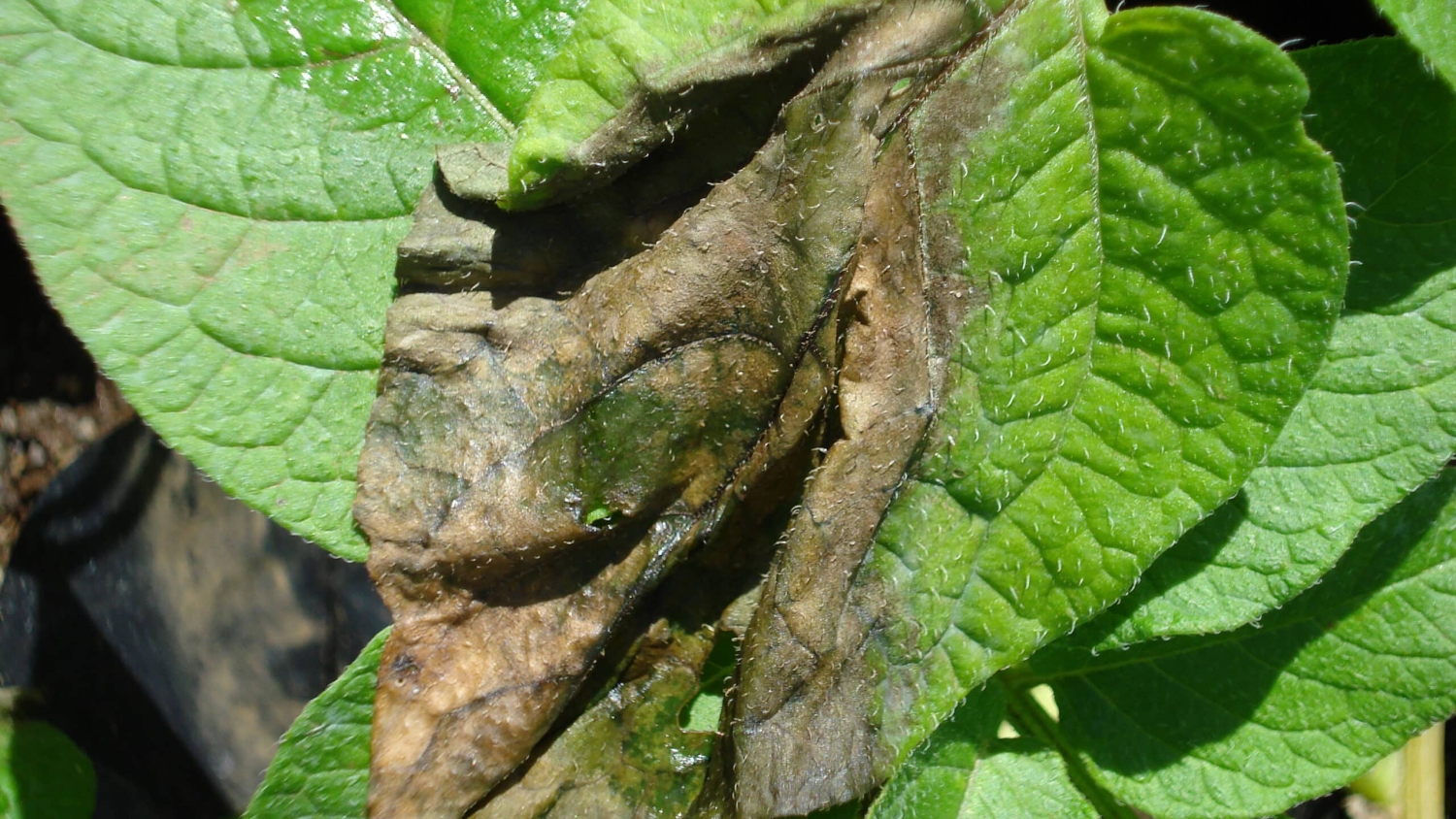
The pathogen, Pseudoperonospora cubensis, causes angular, chlorotic lesions on the foliage. These lesions appear angular because they are bound by leaf veins. During humid conditions, inspection of the underside of the leaf reveals gray-brown to purplish-black ‘down’. This is the sporulation of the pathogen. Magnification of the sporulation reveals the acutely and dichotomously branched sporangiophores bearing lemon-shaped sporangia. Eventually, leaves will turn necrotic and curl upwards. The disease is sometimes called “wildfire” because of how rapidly it progresses, as if burned by fire. Symptoms on watermelon and cantaloupe are different than on other cucurbits; leaf spots are typically not angular and turn brown to black in color. Often, an exaggerated upward leaf curling will occur. Regardless of which cucurbit is involved, only the leaves are infected. However diseased leaves results in two major effects: 1) reduced yields and a greater proportion of mishapen fruit (especially in cucumber) and 2) sunscalded fruit due to increased exposure to direct sunlight (especially in watermelon and winter squash).
Pathogen Biology
Pseudoperonospora cubensis is an obligate parasite or biotroph, meaning that it requires live host tissue in order to survive and reproduce. Because of this feature, the pathogen must overwinter in an area that doesn’t experience a hard frost (e.g., Southern Florida) and wild or cultivated cucurbits are present. The spores are dispersed via wind to neighboring plants and fields and often over long distances. Symptoms appear 4-12 days after infection. The pathogen likes it cool and moist. Optimum conditions for sporulation are 59F with 6-12 hours of moisture present (usually in the form of morning dew). Remember that even when daytime temperatures are not favorable for the pathogen, nighttime temperatures may be ideal. Oospores (thick-walled, resting spores) or P. cubensis are rare and their role in nature is unknown.
Disease Cycle
Pseudoperonospora cubensis is an obligate parasite or biotroph, meaning that it requires live host tissue in order to survive and reproduce. Because of this feature, the pathogen must overwinter in an area that doesn’t experience a hard frost (e.g.,
Oospores (thick-walled, resting spores) of P. cubensis are rare and their role in nature is unknown.
Host Specificity, Pathotypes
Within the cucurbit family, P. cubensis isolates will exhibit a specific host range, that is, it will infect certain cucurbits and not others. For example, we have observed cucumber and squash grown in close proximity while only the cucumber is diseased. When a pathogen exhibits this type of host specificity, it is referred to as a pathotype. At least five pathotypes of P. cubensis have been described in the
Disease Management
Controlling downy mildew requires use of resistant cultivars, fungicide applications and early detection.
Resistant Cultivars
Host resistance is an important tool in disease control and should be used whenever possible. Cultivars resistant to downy mildew have been developed for cucumber and cantaloupe and to a lesser extent for squash and pumpkin. Though cucumber downy mildew has been severe on resistant cultivars, they are more effective than susceptible cultivars in delaying infection.
Chemical Control
Chemical control is highly recommended because downy mildew is an aggressive and destructive diseaseand satisfactory control without the use of fungicides is unlikely. Both protectant and systemic products should be applied. Fungicides are most effective when applied prior to infection and reapplied at 5- to 7-day intervals. The following products have proven to be the most effective fungicides in cucumber downy mildew control in North Carolina: Previcur Flex (propamocarb, Bayer), Tanos (fenamidone + cymoxanil, DuPont), Ranman (cyazofamid, FMC), and Gavel (zoxamide + mancozeb, Dow AgroSciences). These products should be applied in a program to prevent pathogen resistance (i.e., rotated with fungicides of a different mode of action). Protectant fungicides such as chlorothalonil and mancozeb should be used as mixing partners.
| Example Fungicide Program for Cucumber Downy MildewTanos + mancozebalternated withPrevicur Flex + chlorothalonil |
Early Detection
Many growers have lost the battle against downy mildew by waiting until they could clearly see the disease before initiating sprays. Early detection of downy mildew and immediate or preventative fungicide application is imperative for the control of this disease. A forecasting system exists to assist growers in timing their fungicide applications for maximum benefit. The system tracks outbreaks of the disease and provides a forecast or risk assessment for future outbreaks. The forecasts are provided at the following website: http://www.ces.ncsu.edu/depts/pp/cucurbit.**January 2007